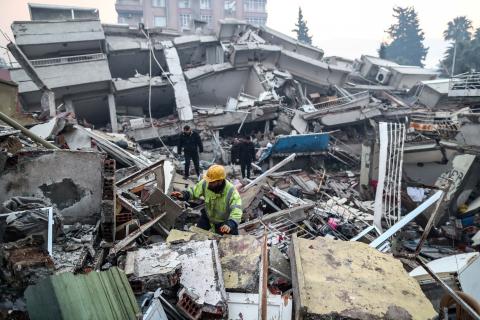
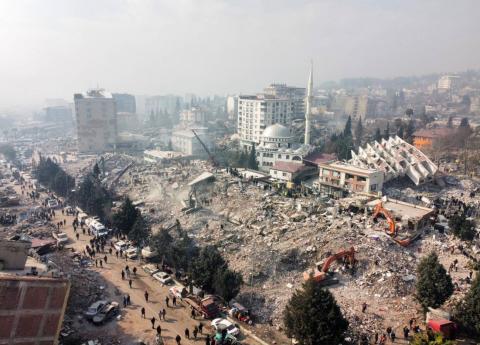
Two consecutive major earthquakes hit Venezuela
Venezuela has been hit by a pair of earthquakes measuring 7.2 and 7.5 on the Richter scale, according to the U.S. Geological Survey (USGS). The quakes struck less than a minute apart and have severely affected the city of Caracas and surrounding areas. Interim President Delcy Rodríguez reported that the death toll has risen from 32 to 164 and the number of injured from 700 to 971. She also declared the state of La Guaira, north of Caracas, a “disaster area” and announced the mobilization of the country’s entire public and private healthcare network.
Update: As of 2 July, the total death toll stands at 2,295 and the number of injured at 11,267.
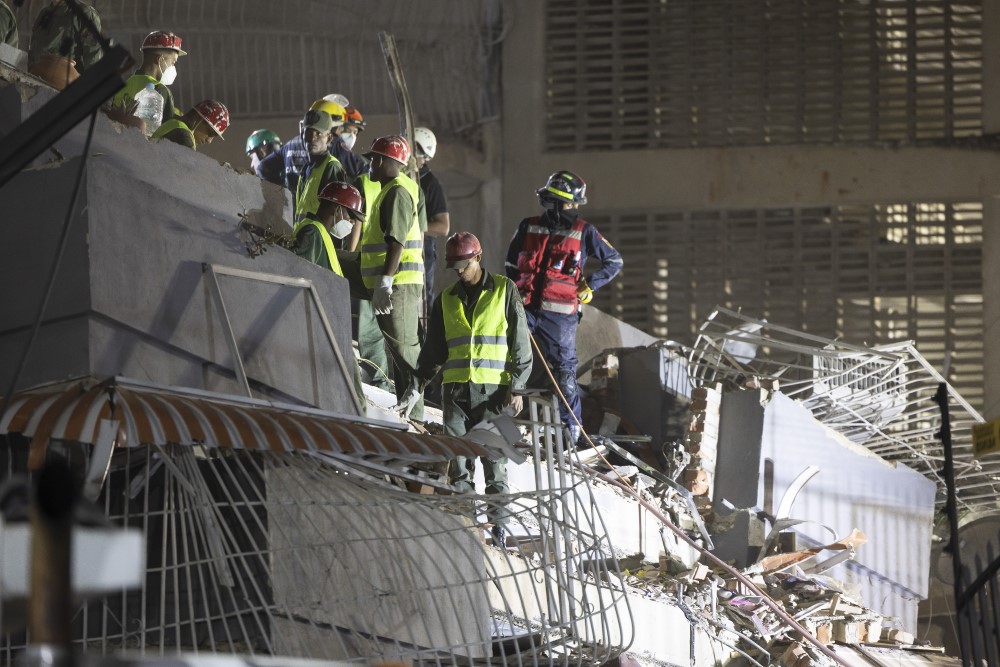
Rescue teams are searching through the rubble in Caracas (Venezuela) following two strong earthquakes that shook the western part of the country's capital; two earthquakes, measuring 7.2 and 2.5 on the Richter scale, that occurred within just 39 seconds of each other. Credit: EFE/Rayner Peña R.
Mark Allen - terremoto Caracas
Mark Allen
Professor in the Department of Earth Sciences at Durham University
The two earthquakes which struck Venezuela on 24/6/26 were unusual for being so close together in time at this scale: a Magnitude 7.2 event was followed only 39 seconds later by a Magnitude 7.5 event. But, it is likely that the first earthquake ruptured one fault segment and transferred stress on to another fault which failed in turn, causing the second earthquake.
The events seem to have taken place on the tectonic plate boundary between South America and the Caribbean. The plates are moving past each other, laterally, in this region - similar to the San Andreas Fault in California.
The epicentres appear to be ~100 miles west of Caracas; whatever the casualties, earthquakes nearer would have been more destructive.
There is a risk of further earthquakes (aftershocks) in the Caracas region: the Venezuelan capital is in an earthquake-prone area, and local faults may have been loaded by the 24/6/26 events
260625_Beatriz_terremoto Venezuela
Beatriz Gaite Castrillo
Deputy Directorate General for Monitoring, Early Warning, and Geophysical Studies, Directorate General of the National Geographic Institute (IGN)
The two earthquakes in Venezuela, measuring 7.2 and 7.5 on the magnitude scale, occurred at 10:04 p.m. UTC—6:00 p.m. in Caracas—40 seconds apart and 5 kilometers apart. Their fault types are also similar—both are strike-slip faults—and they have fairly shallow hypocenters, between 10 and 20 km (according to the USGS).
The damage that this type of shallow, high-magnitude earthquake—especially when they occur in quick succession—can cause is significant due to the minimal attenuation of seismic waves as they reach the surface and, furthermore, the accumulation of the vibrations generated by both earthquakes.
In recorded history, there have been several cases of double earthquakes (doublets). The one most similar to the current event occurred in Pakistan in 1997, with two earthquakes of magnitudes 7.0 and 6.8 occurring 19 seconds apart. In Spain, there have also been earthquakes occurring in quick succession with similar magnitudes. For example, during the 2021 Granada seismic series, three main earthquakes with magnitudes between 4.1 and 4.3 occurred in less than 20 minutes, with an intensity of V (IGN).
After any earthquake that is felt, aftershocks of lower magnitude than the main event usually occur, but it can also happen—as in the case of the earthquakes in Venezuela or Granada—that earthquakes of the same magnitude occur, or even, as in Lorca in 2011, that an earthquake of magnitude 5.1 occurs less than two hours after a magnitude 4.5 earthquake. In this case, the magnitude 4.5 earthquake is called a foreshock.
Maintaining a catalog of earthquakes allows us to better understand the planet’s dynamics and study seismic hazard in order to develop appropriate earthquake-resistant construction plans for each region.
260625_Lucía y Maurizio_terremoto Venezuela
Lucía Escudero Palencia
Pre-doctoral researcher in the Department of Earth Physics and Astrophysics, School of Physical Sciences, Complutense University of Madrid
Maurizio Mattesini
Professor of Geophysics in the Department of Earth Physics and Astrophysics, School of Physical Sciences, Complutense University of Madrid
The earthquakes that occurred in Venezuela on June 24, 2026 (Mw 7.2 and 7.5, respectively, according to the U.S. Geological Survey, USGS) highlight not only the seismic activity in certain regions of the Caribbean (due to the subduction process at the boundary between the Caribbean Plate and the South American Plate), but also the immense destructive power of earthquakes. Earthquakes are natural events that cannot be prevented, but measures can be taken to mitigate the damage they cause. And these earthquakes have demonstrated the growing importance of Early Earthquake Warning Systems (EEWS).
Although it is currently not possible to predict an earthquake before it occurs, EEWS allow us to mitigate the destructive effects of an earthquake and take precautionary measures. An EWS relies on networks of seismic stations that transmit real-time data, enabling the detection of earthquakes in their earliest stages—the P-waves (or primary waves), which are faster (~5.5 km/s) and have low destructive potential—and estimating their magnitude. If the magnitude exceeds a certain threshold, the SAST issues an early warning seconds before the arrival of the most damaging phases, associated with S-waves (or secondary waves) and surface waves, which travel at a slower speed (~3.5 km/s) but are responsible for most of the damage at the surface. The time available from the moment the alert is issued is usually a few seconds and, in some cases, can be as long as nearly a minute. Although this may seem like a short time, various studies have shown that it is sufficient for people to move away from dangerous areas, for emergency protocols to be activated, for industrial processes to be halted, and for the speed of trains and other transportation systems to be reduced.
These systems are already in operation in countries such as Japan, Mexico, Taiwan, and the United States, where they have proven effective in reducing earthquake damage. Furthermore, since 2010, the Complutense University of Madrid has been conducting research to study the feasibility of an SAST in the Ibero-Maghreb region, an area with significant seismic activity and a history of major earthquakes, such as the 1755 Lisbon earthquake. Currently, the SAST is operating on an experimental basis at the UCM, yielding positive results. Furthermore, the Community of Madrid is currently funding a specific thesis contract for this line of research (Pre-doctoral Training Contracts PIPF-2024/COM-34266), focused on the study and implementation of QuakeUp, an innovative SAST based on estimating areas of potential damage in the event of an earthquake.
In the case of Venezuela, numerous users received alerts on their Android cell phones before feeling the most intense shaking, thanks to the Android Earthquake Alerts System, developed by Google. This system relies on networks of accelerometers built into cell phones that act as a distributed network of seismic sensors and applies the same physical principle as SASTs: to detect the early phases of an earthquake and generate real-time alerts.
For some users, the alert arrived just three, five, or ten seconds before the strongest tremor. However, that brief window of time was enough for them to move away from windows or dangerous objects, seek shelter, or take emergency measures. In fact, numerous accounts indicate that these alerts allowed some people to leave the buildings they were in before the strongest tremor struck.
The earthquakes in Venezuela have shown that, although earthquakes cannot be prevented or predicted, it is possible to mitigate some of their consequences through systems capable of quickly detecting the onset of an event and alerting the population. The incorporation of new technologies, such as the mobile phone networks used in this case, also expands the possibilities for monitoring and early warning, especially in regions where conventional seismic networks are more limited.